
Quick Answer
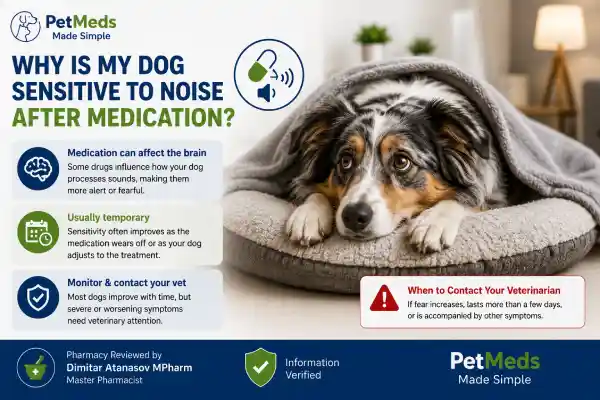
Why is my dog sensitive to noise after medication? Dogs may become unusually sensitive to sounds after medication because certain drugs temporarily affect the brain, hearing pathways, anxiety levels, or overall nervous system activity. While mild noise sensitivity can occur during recovery from anesthesia, pain medications, gabapentin, or anxiety medications, severe fear, panic, disorientation, or sudden behavioral changes should always be discussed with your veterinarian. In many cases, the sensitivity is temporary and improves as the medication wears off, but persistent symptoms may indicate that the medication needs adjustment or that another medical condition is present.
When Owners Commonly Ask This
Owners often search “Why Is My Dog Sensitive to Noise After Medication?” after noticing their normally calm dog suddenly reacting to everyday sounds.
Common situations include:
- Barking at ordinary household noises
- Jumping when a door closes
- Becoming frightened by the television
- Hiding during thunderstorms despite previously remaining calm
- Startling easily when someone speaks
- Reacting strongly to kitchen noises
- Becoming anxious after returning home from surgery
- Acting differently after starting a new medication
Many owners worry that something has gone seriously wrong. Fortunately, increased sensitivity to sound is often temporary, especially during the first few days after starting certain medications.
Understanding why your dog is sensitive to noise after medication can help you decide whether careful monitoring is appropriate or whether veterinary attention is needed.
Why Is My Dog Sensitive to Noise After Medication?
Can Medication Really Make Dogs More Sensitive to Noise?
Yes.
One of the first questions owners ask is:
“Why Is My Dog Sensitive to Noise After Medication?”
The answer is that some medications temporarily change how the brain processes sensory information.
Instead of simply making a dog sleepy, certain medications can alter:
- Awareness
- Anxiety levels
- Sound processing
- Alertness
- Startle responses
- Emotional reactions
- Coordination
- Overall brain activity
As these changes occur, completely ordinary sounds may suddenly seem much more noticeable or frightening.
Most dogs improve once their bodies adjust to the medication or after the drug leaves their system.
Which Medications May Cause Noise Sensitivity?
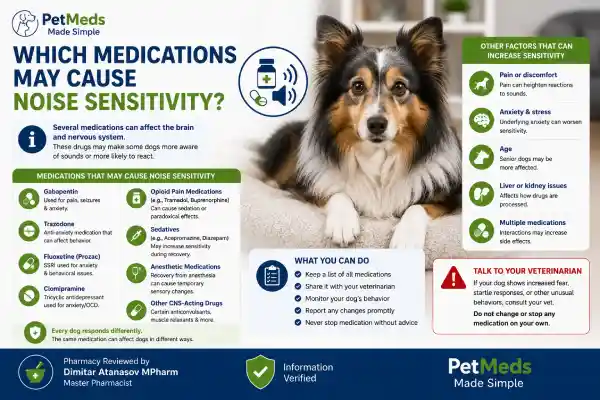
Several medications have the potential to affect a dog’s response to sounds.
Examples include:
- Gabapentin
- Trazodone
- Fluoxetine
- Clomipramine
- Opioid pain medications
- Certain sedatives
- Medications used before anesthesia
- Some post-operative pain medications
The medication itself is not always directly responsible.
Sometimes the dog’s underlying illness, pain, or recovery from surgery contributes to the behavioral change.
Why Does This Happen?
The brain constantly filters incoming information.
Normally, dogs ignore thousands of harmless sounds every day.
Medication may temporarily change this filtering process by affecting neurotransmitters involved in:
- Pain perception
- Anxiety
- Emotional regulation
- Sensory processing
- Sleep-wake cycles
- Stress responses
As a result, harmless sounds may suddenly seem unusual or threatening.
This explains why owners frequently search Why Is My Dog Sensitive to Noise After Medication? shortly after beginning treatment.
Is Noise Sensitivity Always Caused by the Medication?
No.
This is one of the most important things owners should understand.
Although medication may contribute, several other factors may also be involved.
These include:
- Pain
- Stress
- Hospitalization
- Sleep deprivation
- Post-surgical recovery
- Hearing disorders
- Vision changes
- Anxiety disorders
- Cognitive dysfunction in senior dogs
Your veterinarian will consider all of these possibilities before concluding that the medication is responsible.
Which Dogs Are Most Likely to Develop Noise Sensitivity?
Not every dog reacts the same way.
Dogs that may be more susceptible include:
- Senior dogs
- Naturally anxious dogs
- Dogs with previous noise phobias
- Dogs recovering from surgery
- Dogs receiving multiple medications
- Dogs with neurological disorders
- Dogs experiencing chronic pain
- Dogs with reduced vision or hearing
Individual temperament also plays an important role.
Some dogs are naturally much more sensitive to changes in their environment than others.
Could Anxiety Medication Cause Noise Sensitivity?
Surprisingly, yes.
Although anxiety medications are intended to reduce fear, the first few days of treatment can sometimes produce temporary behavioral changes while the brain adapts.
Some dogs may become:
- More alert
- Restless
- Easily startled
- Hyper-aware of their surroundings
This is one reason we often recommend owners also read:
- Can Anxiety Medication Cause Weakness in Dogs?
- Why Does Anxiety Medication Stop Working?
- Can Dogs Become Emotionally Numb on Anxiety Medication?
- Why Is My Dog Suddenly Afraid of Everything?
- Can Anxiety Medication Cause Vomiting in Dogs?
These conditions may overlap, particularly during the first weeks of treatment.
Can Gabapentin Make Dogs React to Sounds?

Yes, although it usually has the opposite effect.
Gabapentin is commonly prescribed to reduce pain and anxiety, but individual responses vary.
Some dogs become:
- Very sleepy
- Relaxed
- Less reactive
Others may experience:
- Mild confusion
- Increased alertness
- Restlessness
- Temporary behavioral changes
This variability explains why some owners specifically ask Why Is My Dog Sensitive to Noise After Medication? after starting gabapentin.
If your dog is taking gabapentin, you may also find these PMMS guides helpful:
- Why Is My Dog Hyper After Gabapentin?
- Can Gabapentin Cause Anxiety in Dogs?
- Why Is My Dog Panting After Gabapentin?
- Can Dogs Become Addicted to Gabapentin?
- Can Dogs Take Gabapentin Long-Term Safely?
- Can Dogs Take Gabapentin and NSAIDs Together?
- Why Is My Dog Falling Over After Gabapentin?
- Can Gabapentin Cause Neurological Side Effects?
Understanding the full range of possible side effects provides a much clearer picture than looking at one symptom in isolation.
Could Pain Itself Make Dogs More Sensitive to Noise?
Absolutely.
Pain changes the way the nervous system responds to the environment.
A dog experiencing discomfort may:
- Sleep lightly
- Startle more easily
- Become irritable
- Avoid interaction
- React to small noises
- Prefer quiet environments
Sometimes owners blame the medication when untreated pain is actually the primary reason their dog seems unusually sensitive.
This is especially common after orthopedic surgery or dental procedures.
Common Signs That May Accompany Noise Sensitivity
Dogs rarely become sensitive to sound without showing other behavioral changes.
Owners may also notice:
| Symptom | Common? |
|---|---|
| Hiding | ✓ |
| Trembling | ✓ |
| Panting | ✓ |
| Restlessness | ✓ |
| Pacing | ✓ |
| Dilated pupils | ✓ |
| Clinginess | ✓ |
| Reduced appetite | Sometimes |
| Sleeping more | Sometimes |
| Hypervigilance | Sometimes |
Many of these symptoms are discussed in greater detail throughout our PMMS medication safety library, helping owners understand how seemingly unrelated behaviors can actually be connected.
Can Recovery After Surgery Make Noise Sensitivity Worse?
Yes.
Dogs recovering from surgery are often experiencing several changes simultaneously.
These include:
- Residual anesthesia
- Pain medications
- Physical discomfort
- Fatigue
- Temporary disorientation
- Unfamiliar smells from the veterinary hospital
Together, these factors can make a recovering dog react more strongly to sounds that would normally be ignored.
For many dogs, this sensitivity gradually decreases over the next day or two as recovery progresses.
Can Rebound Anxiety Make Dogs More Sensitive to Noise?
Yes.
One possible explanation for Why Is My Dog Sensitive to Noise After Medication? is rebound anxiety.
Rebound anxiety occurs when the effects of a medication begin wearing off, causing anxiety symptoms to temporarily return—sometimes more intensely than before.
Owners may notice their dog becoming:
- Startled by everyday sounds
- Restless
- Hyper-alert
- Clingy
- Unable to settle
- More reactive than usual
Although rebound anxiety is not seen with every medication, it can occur with certain anti-anxiety drugs or sedatives.
If you suspect this is happening, our PMMS articles What Causes Rebound Anxiety in Dogs?, Why Does Anxiety Medication Stop Working?, and Can Dogs Develop Tolerance to Xanax? provide more detailed information.
Could Hearing Become More Sensitive?
Usually, the dog’s hearing itself has not become stronger.
Instead, the brain may temporarily interpret sounds differently.
Think of it as turning up the “volume” on the emotional response rather than improving hearing.
For example, a refrigerator humming or a spoon falling onto the floor may suddenly trigger:
- Barking
- Trembling
- Hiding
- Running away
- Looking frightened
This is why owners often describe the behavior as “sensitive hearing,” even though the ears themselves are functioning normally.
How Long Does Noise Sensitivity Last?
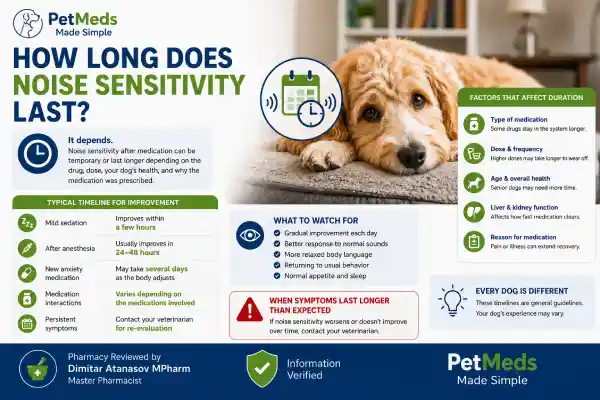
The duration depends on several factors.
These include:
- Which medication was prescribed
- The dose
- Your dog’s age
- Kidney and liver function
- Whether multiple medications are being used
- The reason the medication was prescribed
For many dogs, improvement begins as the medication is metabolized.
| Situation | Typical Expectation |
|---|---|
| Mild sedation | Improves within several hours |
| After anesthesia | Usually improves over 24–48 hours |
| New anxiety medication | May take several days while the body adjusts |
| Medication interactions | Depends on the drugs involved |
| Persistent symptoms | Veterinary re-evaluation recommended |
If the behavior becomes progressively worse instead of improving, contact your veterinarian.
Are Senior Dogs More Likely to Experience Noise Sensitivity?
Yes.
Senior dogs often process medications differently.
Age-related changes may include:
- Reduced liver function
- Reduced kidney function
- Cognitive dysfunction
- Hearing loss
- Poor vision
- Arthritis
- Slower metabolism
These changes can make older dogs more vulnerable to temporary neurological side effects.
A senior dog may appear:
- More confused
- Easier to startle
- More anxious
- Less confident
- More reactive to sounds
If your older dog has recently started medication, careful observation is especially important.
Could Cognitive Dysfunction Be Responsible?
Sometimes.
Older dogs with canine cognitive dysfunction syndrome may naturally become more anxious and more sensitive to environmental changes.
Medication may simply make an existing problem easier to notice.
Signs of cognitive dysfunction include:
- Nighttime restlessness
- Confusion
- Pacing
- Staring at walls
- Changes in sleep patterns
- Increased anxiety
- Becoming frightened more easily
If these signs appeared before medication was started, another underlying condition may be contributing.
Can Medication Interactions Increase Noise Sensitivity?
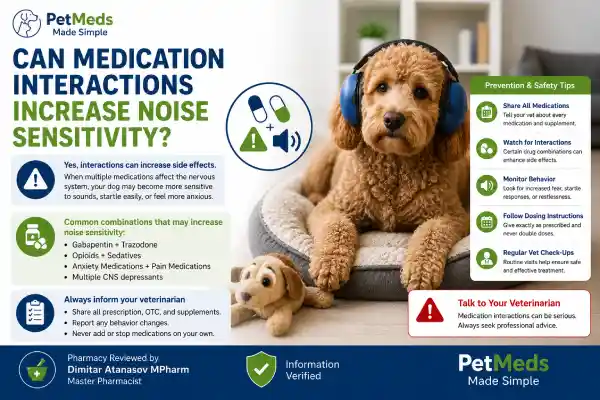
Yes.
Some medications influence the central nervous system in similar ways.
When combined, they may increase side effects.
Examples include combinations involving:
- Gabapentin
- Trazodone
- Opioids
- Sedatives
- Anti-anxiety medications
This does not necessarily mean the combination is unsafe.
Many dogs safely receive multiple medications under veterinary supervision.
However, unexpected behavioral changes should always be reported.
Our article Can Dogs Take Pain Medication With Antibiotics? explains why discussing every medication with your veterinarian is important, even when the drugs appear unrelated.
Could Pain Medication Affect My Dog’s Behavior?
Absolutely.
Pain medications do much more than reduce discomfort.
Some dogs become:
- Sleepier
- Calmer
- Less active
Others may temporarily become:
- Restless
- More vocal
- Less interested in food
- More sensitive to their surroundings
Behavioral changes should always be interpreted together with the dog’s overall recovery.
Related PMMS guides include:
- Can Pain Medication Cause Anxiety in Dogs?
- Why Is My Dog Weak After Pain Medication?
- Why Is My Dog Panting After Pain Medication?
- Why Is My Dog Crying Even After Pain Medication?
- Can Dogs Take Pain Medication Long-Term?
- Can Dogs Take Pain Medication With Antibiotics?
- Can Pain Medication Affect Appetite in Dogs?
- Why Does My Dog Look Sad After Medication?
Looking at the complete picture often makes the cause much easier to understand.
Home Monitoring Checklist
Owners can monitor several signs while their dog recovers.
| Monitor | Normal Finding |
|---|---|
| Eating | Appetite gradually returns |
| Drinking | Drinks normally |
| Walking | Stable without falling |
| Alertness | Improving each day |
| Response to sounds | Becoming less reactive |
| Sleeping | Able to rest comfortably |
| Anxiety | Gradually decreasing |
| Breathing | Calm and regular |
Keeping a simple daily record can help identify improvement or worsening symptoms.
How Can Owners Help at Home?
Most dogs benefit from a calm recovery environment.
Helpful strategies include:
- Keep the home quiet.
- Avoid loud music.
- Close windows during fireworks or storms.
- Provide a comfortable resting area.
- Maintain normal feeding routines.
- Allow uninterrupted sleep.
- Avoid forcing interactions.
- Use calm, reassuring voices.
- Keep lighting soft during the evening.
These simple measures often reduce stress while the medication wears off.
Should I Continue Giving the Medication?
In most situations, yes—unless your veterinarian advises otherwise.
Owners sometimes stop medication immediately after asking Why Is My Dog Sensitive to Noise After Medication?
However, stopping medication without veterinary guidance may:
- Allow pain to return.
- Increase anxiety.
- Delay recovery.
- Cause withdrawal with certain medications.
- Make it more difficult to evaluate what is actually causing the behavior.
Instead, contact your veterinarian and describe exactly what you have observed.
When Should Owners Contact Their Veterinarian?
Arrange a veterinary evaluation if your dog:
- Remains unusually frightened for more than expected.
- Becomes increasingly anxious.
- Stops eating.
- Develops repeated vomiting.
- Cannot rest.
- Shows severe behavioral changes.
- Appears confused or disoriented.
- Experiences seizures.
- Develops difficulty walking.
Early communication often allows simple adjustments before symptoms become more significant.
Emergency Warning Signs
Seek immediate veterinary care if your dog develops:
| Emergency Sign | Why It Matters |
|---|---|
| Seizures | Medical emergency |
| Collapse | Immediate evaluation required |
| Difficulty breathing | Life-threatening |
| Loss of consciousness | Emergency |
| Severe aggression | May indicate significant neurological changes |
| Continuous disorientation | Requires urgent assessment |
| Inability to stand | Not considered a routine medication effect |
| Blue or pale gums | Poor oxygenation or circulation |
These symptoms should never be dismissed as normal medication side effects.
Does Every Dog Recover Completely?
Fortunately, most dogs do.
If you’re asking “Why Is My Dog Sensitive to Noise After Medication?”, the good news is that medication-related noise sensitivity is usually temporary.
As the medication is metabolized or as your dog’s body adjusts to treatment, most dogs gradually become less reactive to sounds.
Recovery depends on several factors, including:
- The medication prescribed
- The dose
- The dog’s age
- Overall health
- Liver and kidney function
- The condition being treated
- Whether other medications are also being given
Dogs that develop only mild behavioral changes often return to normal without requiring any changes to their treatment plan.
Can the Dose Be Adjusted?
Yes.
If your veterinarian determines that the medication is responsible, they may recommend:
- Lowering the dose
- Giving the medication at a different time of day
- Splitting the daily dose
- Increasing the interval between doses
- Switching to another medication
- Using combination therapy with lower doses of multiple medications
Every dog responds differently.
A dose that works perfectly for one dog may produce noticeable side effects in another.
Owners should never change the dosage on their own without veterinary guidance.
Can Noise Sensitivity Be Prevented?

Sometimes.
Although no medication is completely free from side effects, several simple steps can reduce the risk of behavioral changes.
| Prevention Strategy | Why It Helps |
|---|---|
| Give medication exactly as prescribed | Reduces unexpected drug levels |
| Never double a missed dose | Helps avoid excessive side effects |
| Inform your veterinarian about all medications | Reduces interaction risks |
| Report previous medication reactions | Allows individualized treatment |
| Schedule follow-up visits | Ensures appropriate dose adjustments |
| Keep recovery environments calm | Minimizes external stress |
Preventing stress is often just as important as choosing the correct medication.
Should Owners Keep a Behavior Diary?
Yes.
A simple diary can help identify patterns that may otherwise be missed.
Record:
- When the medication was given.
- When the noise sensitivity began.
- Which sounds caused reactions.
- How severe the reaction was.
- How long the episode lasted.
- Any additional symptoms.
This information helps veterinarians determine whether the medication, the underlying illness, or another factor is responsible.
Could Stress at Home Make the Problem Worse?
Absolutely.
Dogs recovering from illness or surgery are often more emotionally sensitive.
Additional stressors such as:
- Visitors
- Children playing loudly
- Fireworks
- Thunderstorms
- Construction noise
- Vacuum cleaners
- Multiple pets
may make medication-related noise sensitivity appear much worse.
Whenever possible, provide a predictable, quiet environment until recovery is complete.
Does Every Medication Affect Dogs the Same Way?
No.
One reason owners search Why Is My Dog Sensitive to Noise After Medication? is because experiences vary greatly.
Two dogs receiving the same medication at the same dose may respond very differently.
Factors influencing the response include:
- Breed
- Age
- Genetics
- Body weight
- Liver function
- Kidney function
- Previous exposure to the medication
- Underlying anxiety disorders
This variability is one of the reasons veterinarians individualize treatment rather than using identical doses for every patient.
Related Symptoms Owners Often Notice
If you’re researching Why Is My Dog Sensitive to Noise After Medication?, you may also notice other behavioral changes.
Many owners also search for:
- Why Is My Dog Acting Confused After Medication?
- Why Does My Dog Look Sad After Medication?
- Why Is My Dog Hyper After Gabapentin?
- Can Gabapentin Cause Anxiety in Dogs?
- Why Is My Dog Panting After Gabapentin?
- Why Is My Dog Weak After Pain Medication?
- Can Pain Medication Cause Anxiety in Dogs?
- Why Is My Dog Crying Even After Pain Medication?
- Why Is My Dog Acting Strange After Antibiotics?
- Why Is My Dog Panting After Antibiotics?
- Why Does My Dog Refuse Water After Medication?
- Can Dogs Take Pain Medication With Antibiotics?
- Can Dogs Take Human Sleeping Pills?
- Can Dogs Take Benadryl for Anxiety?
- Why Is My Dog Suddenly Afraid of Everything?
These articles are part of the PMMS medication safety library and help explain how different medications can influence canine behavior, appetite, balance, sleep, and recovery.
Veterinarian Takeaway
Why Is My Dog Sensitive to Noise After Medication? In many cases, temporary sensitivity to sounds occurs because medications influence the central nervous system, altering how the brain processes normal sensory information.
Fortunately, most cases improve as the medication wears off or as the dog’s body adjusts to treatment.
However, severe fear, progressive neurological signs, collapse, seizures, inability to walk, or persistent behavioral changes are not considered normal and should be evaluated promptly by a veterinarian.
Owners should never stop prescription medications without professional guidance, as doing so may worsen the underlying condition or interfere with recovery.
Bottom Line
Why Is My Dog Sensitive to Noise After Medication? The answer is often multifactorial.
Medication may temporarily affect the brain’s response to sound, but pain, recovery from surgery, anxiety, hospitalization, and underlying medical conditions may also contribute.
Most dogs improve with time, careful monitoring, and appropriate veterinary guidance.
Providing a calm environment, following the prescribed treatment plan, and reporting any unusual behavioral changes to your veterinarian are the best ways to support your dog’s recovery.
If the sensitivity becomes severe, worsens over time, or is accompanied by other concerning symptoms, seek veterinary advice promptly.
Frequently Asked Questions
Can medication make dogs sensitive to noise?
Yes. Certain medications can temporarily affect the central nervous system, making some dogs more reactive to everyday sounds. If you’re wondering “Why Is My Dog Sensitive to Noise After Medication?”, mild noise sensitivity can occur with medications such as gabapentin, trazodone, some pain medications, sedatives, and during recovery from anesthesia.
Is noise sensitivity after medication normal?
Mild, temporary noise sensitivity can be normal in some dogs, particularly during the first few hours or days after starting a new medication. However, severe panic, continuous fear, confusion, seizures, or worsening neurological signs are not considered normal and require veterinary evaluation.
Which medications are most likely to cause noise sensitivity?
Although every dog responds differently, medications that may contribute include:
Gabapentin
Trazodone
Fluoxetine
Clomipramine
Opioid pain medications
Sedatives
Some anesthetic medications
Sometimes the medication is only part of the explanation, with pain, stress, or recovery also contributing.
How long does noise sensitivity last?
or many dogs, the increased sensitivity improves as the medication wears off.
The duration depends on:
The medication used
The prescribed dose
Your dog’s age
Liver and kidney function
Other medications
The underlying medical condition
If symptoms continue for longer than expected or become progressively worse, contact your veterinarian.
Should I stop giving the medication?
No not unless your veterinarian tells you to.
Stopping prescription medications suddenly may:
Allow pain to return
Worsen anxiety
Delay recovery
Increase the risk of withdrawal with certain medications
Always speak with your veterinarian before making any changes to your dog’s treatment plan.
Can pain itself make dogs more sensitive to sounds?
Absolutely.
Dogs experiencing pain often become more alert to their surroundings. Even without medication, discomfort may cause dogs to:
Startle easily
Sleep lightly
Become irritable
Prefer quiet places
Avoid busy environments
Sometimes untreated pain not the medication is the primary reason for the behavioral change.
Are senior dogs more likely to become sensitive to noise?
Yes.
Older dogs may metabolize medications more slowly and are also more likely to have:
Cognitive dysfunction
Arthritis
Reduced vision
Hearing changes
Chronic medical conditions
These factors may increase sensitivity to environmental changes after medication.
Can medication interactions make the problem worse?
Yes.
Combining medications that affect the nervous system may increase temporary side effects.
This is why your veterinarian should always know about:
Prescription medications
Over-the-counter medications
Supplements
Herbal products
CBD products
Never add new medications without veterinary approval.
When should I call my veterinarian?
Contact your veterinarian if your dog:
Remains frightened for more than expected.
Stops eating.
Becomes increasingly anxious.
Cannot sleep or settle.
Develops repeated vomiting.
Shows worsening confusion.
Begins stumbling or collapsing.
Develops new neurological symptoms.
Early communication often allows simple treatment adjustments before symptoms become more serious.
When is noise sensitivity an emergency?
Seek immediate veterinary care if your dog develops:
Seizures
Collapse
Difficulty breathing
Loss of consciousness
Severe aggression
Continuous disorientation
Inability to stand
Blue or pale gums
These symptoms are not considered routine medication side effects and require immediate evaluation.
Sources
- Plumb’s Veterinary Drug Handbook
- Merck Veterinary Manual
- BSAVA Small Animal Formulary
- Veterinary Pharmacology and Therapeutics
- Small Animal Clinical Pharmacology
- American Animal Hospital Association (AAHA) Clinical Guidelines
- American Veterinary Medical Association (AVMA)
- Veterinary Information Network (VIN)
- Journal of the American Veterinary Medical Association (JAVMA)
- Frontiers in Veterinary Science
- Veterinary Anaesthesia and Analgesia
- Today’s Veterinary Practice
Medical Review Statement
This article was pharmacy-reviewed by Dimitar Georgiev Atanasov, MPharm (Bulgarian Pharmaceutical Union, UIN: 0210000586) and independently veterinary-reviewed by Dr. Valcho Georgiev Valchev, DVM (Bulgarian Veterinary Union, Registration No. 28000115) to ensure medical accuracy, medication safety, and consistency with current veterinary standards.
Important Medical Disclaimer
The information provided on PetMedsMadeSimple.com is intended for educational purposes only and should not replace professional veterinary advice, diagnosis, or treatment.
Every dog responds differently to medication. Never start, stop, or change the dosage of any prescription medication without consulting your veterinarian. If your dog develops severe behavioral changes, seizures, collapse, breathing difficulties, or any other emergency symptoms, seek immediate veterinary care.
For more information about how we create and review our content, please read our Editorial Policy, Medical Review Process, and About Us pages.
Image Disclosure
Some images used in this article may be AI-generated or AI-assisted for educational purposes. Every article is independently researched, pharmacy-reviewed by Dimitar Georgiev Atanasov, MPharm, and veterinary-reviewed by Dr. Valcho Georgiev Valchev, DVM. AI-generated illustrations are intended to improve understanding of veterinary concepts and do not depict actual clinical patients.